

Blog
What Causes Office Chair Discomfort During Long Working Hours?
The Global Burden of Disease Study 2021, published in The Lancet, found that low back pain affected 619 million people worldwide and remains the leading cause of disability globally.
UAE offices running 8 to 10 hour days are a direct part of that picture. Most chair discomfort is not random. It comes from specific design and setup failures.
This article breaks down the causes, the UAE factors that make them worse, and what to look for in a chair that prevents them.
The Most Common Causes of Chair Discomfort
Chair discomfort during long working hours almost always traces back to one or more of these six failures. Most of the offices we supply across Dubai and Abu Dhabi use task chairs as their primary seating. The specification of that one product affects every person on the floor, every day.
| Cause | Body Area Affected | What Happens Over Time |
| No lumbar support | Lower back | Spine flattens, slouching sets in, chronic pain follows |
| Wrong seat height | Legs and hips | Circulation restricted, thighs compress, feet unsupported |
| Fixed or missing armrests | Shoulders and neck | Muscles hold arm weight all day, tension builds |
| Seat too deep or shallow | Thighs and lower back | Pressure behind knees or gap between back and support |
| Non-breathable upholstery | Full body | Overheating, restlessness, fatigue accelerates |
| No tilt or recline | Spine | Static load builds on discs, no pressure relief |
None of these failures are minor after two hours. After eight, they compound into the kind of discomfort that affects focus, mood, and the following morning.
Why UAE Working Hours Make These Issues Worse
8-10 Hours Compounds Every Design Flaw
A poorly designed chair feels fine for the first hour. The problems show up in hours four to six when fatigue sets in and posture collapses. UAE physiotherapists quoted in Khaleej Times confirm that ergonomic injury is tied directly to sustained poor seating across long working days.
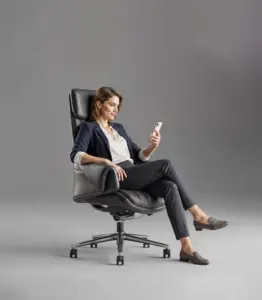
Finance teams in DIFC and legal firms in Abu Dhabi are the most common cases we see. Ten-hour days are standard in both sectors, and by hour six, every unaddressed chair failure is fully visible in how people are sitting.
UAE’s Diverse Workforce Needs a Wider Adjustment Range
The effective height range across a standard UAE office workforce runs from 155cm to 195cm. A chair with a fixed seat height or narrow adjustment cannot support that span. When it does not fit the person sitting in it, every hour creates compounding postural strain regardless of what the chair costs.
Air Conditioning and Upholstery
Most clients who switch from PU leather to mesh notice the difference within the first month. The afternoon fatigue drops before anything else does. UAE offices run heavy air conditioning year-round, but PU leather and foam upholstery still trap heat. Mesh allows airflow even in a cooled room, which matters more across a full working day than most people expect.
The Ramadan Factor
Reduced Hours, Higher Ergonomic Risk
UAE Labour Law reduces working hours by two hours per day during Ramadan. On paper that seems easier on the body. In practice, fasting, altered sleep, and reduced hydration create a higher ergonomic risk, not a lower one. Fatigue sets in earlier and tolerance for a poor chair drops fast.
Why Existing Chair Problems Get Worse
A chair that felt fine in January can feel genuinely uncomfortable by the third week of Ramadan. The body has less capacity to compensate for what the chair is not providing. This is when poor seating decisions made at fit-out stage become visible across the whole team.
What Each Symptom Tells You About the Chair
If your team is reporting specific types of discomfort, each one points to a specific chair failure.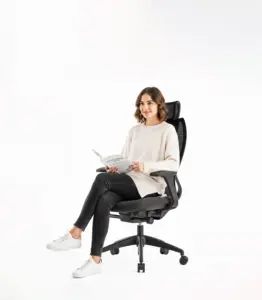
Lower Back Pain
The lumbar support is absent, fixed, or in the wrong position. A good lumbar mechanism adjusts both height and depth to match the natural curve of each individual spine. For senior roles sitting through long client-facing days, executive chairs combine high-back lumbar support with the aesthetic specification those offices require.
Neck and Shoulder Tension
Armrests are fixed, too low, or missing entirely. When armrests cannot be adjusted to the correct height and width for the task, the shoulders carry the weight of the arms all day. That load transfers into neck and upper back tension by mid-afternoon. A properly specified task chair includes 4D armrests as standard, not as an upgrade.
Leg Numbness or Circulation Issues
The seat is too deep for the person sitting in it or too high for their leg length. Seat depth adjustment is one of the most overlooked ergonomic features. Without it, the front edge of the seat presses against the back of the thighs, restricting circulation and causing the numbness and restlessness that people misattribute to simply sitting too long.
Fatigue by Midday
The chair offers no tilt or recline. A fixed backrest locks the body into one position and forces the spine to carry a static load with no opportunity for pressure relief. Controlled recline, even a few degrees, redistributes spinal load throughout the day and reduces fatigue noticeably.
What to Look for in a Chair That Prevents These Issues
Not all chairs are built for this. Meeting chairs are designed for short sessions, not eight-hour workdays. Using one as a daily work seat is one of the most common specification errors we see across UAE offices. The features below are what separate a proper task chair from everything else:
- Adjustable lumbar support with both height and depth control, not a fixed pad
- Seat height range covering 42-54 cm minimum to serve the UAE’s workforce height range
- Seat depth adjustment to eliminate thigh pressure for shorter-statured employees
- 4D adjustable armrests that move in, out, forward, up and down
- Breathable mesh backrest rated for extended use in air-conditioned environments
- Controlled tilt with tension adjustment so recline works with body weight, not against it
- BIFMA certification confirming the chair has been tested for long-term commercial use
If the chair you are evaluating cannot confirm all of these, it is not an ergonomic chair. It is a chair marketed as one.
Conclusion
Most office chair discomfort is preventable. The causes are specific, the fixes are known, and the chairs that address them properly are available in the UAE market right now. If your team is reporting back pain, fatigue, or restlessness by midday, that is the chair telling you something.